The 8 Limbs of Muay Thai Explained: Punches, Kicks, Knees, and Elbows
If you’re a beginner in Morris County, whether you’re coming from Randolph, Dover, Morristown, or Rockaway, and you’ve been wondering what really makes Muay Thai different from regular kickboxing, you’re not alone. Most new students step into the gym excited, but also overwhelmed by the terminology, the footwork, and especially the “eight limbs” everyone keeps talking about. The truth is, without proper guidance, it’s easy to feel lost or worry you’re practicing techniques incorrectly, which slows progress and kills confidence. At Morris County Wrestling & Martial Arts, our coaches, led by father-son team Mike and Vic Amada, break things down in a way that makes the art accessible, safe, and genuinely fun, even if you’ve never thrown a strike before.
A Quick Hook: The Surprising Power of the Eight Limbs
Here’s the thing most people don’t realize: Muay Thai isn’t just punching and kicking. It turns your entire body into a striking toolbox, fists, shins, elbows, and knees, giving you eight distinct weapons to work with. That’s why it’s known worldwide as The Art of Eight Limbs.
Once you see how these “weapons” work together, everything about Muay Thai starts to make sense.
What Do the 8 Limbs Mean in Muay Thai?
The “eight limbs” are simply the eight points of contact your body can use to strike:
- 2 fists
- 2 shins
- 2 elbows
- 2 knees
These aren’t random body parts. They each serve a purpose depending on distance, timing, and strategy.
The Four Major Weapon Systems (Punches, Kicks, Knees, Elbows)
1. Punches (Fists): Your Setup Tools & Range Finders
Punches in Muay Thai feel familiar because they overlap with traditional boxing: jabs, crosses, hooks, uppercuts. But here’s what makes them uniquely Muay Thai. They’re rarely used alone. Punches are setup tools; ways to measure distance, distract your opponent, or draw their guard out of position so you can land kicks, knees, or elbows.
Common applications:
- Jab – Cross – Right Kick (classic Thai combination)
- Cross. Switch Kick
- Jab to force the guard high. Teep to the body
And when beginners train here in Randolph, it’s usually the punches that help them relax into the rhythm of the sport.
2. Kicks (Shins): The Power Strikes of Muay Thai
If punches are your setups, kicks are your power shots, especially the roundhouse kick delivered with the shin, not the foot.
This matters because:
- The shin is thick, durable bone.
- It’s trained to absorb impact.
- When conditioned, it becomes a devastating weapon.
Types of kicks you’ll learn:
- Roundhouse Kick (Teh): Delivered like swinging a baseball bat.
- Teep (Push Kick): A long-range tool to keep distance.
- Switch Kick: A lightning-fast stance change to generate power.
- Low Kick: Targets the thigh to break structure.
Students from Rockaway often arrive surprised at how quickly shin conditioning improves. It’s one of those quirks of Muay Thai training that looks intimidating but becomes second nature with the right coaching.
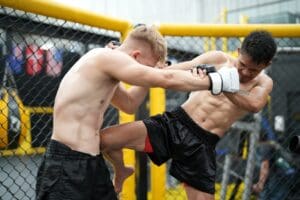
3. Knees (Khao): Dominant Weapons in the Clinch
This is where Muay Thai separates itself from almost every other striking art.
Knees are used in:
- Mid-range.
- Close-range.
- And especially the clinch, a stand-up grappling position.
Why they matter:
- Knees cause serious damage with short travel.
- They disrupt breathing.
- They score highly in traditional Muay Thai competition.
- They’re some of the most effective real-world self-defense tools.
Examples you’ll practice:
- Straight knee
- Diagonal knee
- Curved knee
- Jumping knee
New students often underestimate how technical knees are. Mike Amada’s clinch-focused drills help build that understanding step by step so you don’t feel lost in close-range work.
4. Elbows (Sok): The Razor-Sharp Close-Range Strikes
If kicks are the bat, elbows are the blades. Many fighters call them the most feared weapons in Muay Thai, because of the following reasons:
- Short travel
- Huge cutting potential
- Perfect for clinch or tight inside fighting
- Difficult for opponents to see coming
Elbow variations include:
- Horizontal elbow
- Upward elbow
- Downward elbow
- Spinning elbow
A fun truth from the mats: Most beginners at MCWMA are surprised at how natural elbows feel once they’re coached correctly.
Why Muay Thai Integrates All Eight Limbs Together
Isolation is just the starting point. The real beauty of Muay Thai is how seamlessly the weapons transition:
- Long-range: Kicks and teeps
- Mid-range: Punches and body kicks
- Close-range: Knees and elbows
Training under coaches who genuinely understand these transitions is what helps students level up quickly.
And this is where the structure at Morris County Wrestling & Martial Arts makes a difference: their sessions aren’t rushed, cookie-cutter drills. Each class flows, warm-up, technique, controlled drilling, partner combinations, clinch work, conditioning, so you understand not just what to do, but why you’re doing it.
Key Elements That Make Muay Thai Unique
The Clinch
Most martial arts separate striking and grappling. Muay Thai blends them. The clinch is where knees and elbows shine.
Weapon Hardening
Through safe, progressive training:
- Shins toughen.
- Forearms become stable blocks.
- Elbows gain structural confidence.
Students never force themselves into conditioning. MCWMA coaches ensure it’s done intelligently, not recklessly.
Efficiency
Every strike uses your whole body: hips, core, rotation. This is why even smaller athletes from Morristown can generate massive power.
Frequently Asked Questions
What are the 8 points of contact in Muay Thai?
Fists, elbows, knees, and shins; two of each, totaling eight.
Does Muay Thai use knees and elbows?
Absolutely. Knees and elbows are central to Muay Thai and one of its defining features.
What limbs do you use in Muay Thai?
All four primary striking systems: hands, feet/shins, elbows, and knees.
Why Learning the Eight Limbs Matters for Your Muay Thai Journey

When you understand the purpose behind each limb, training becomes safer, smarter, and way more exciting. Instead of feeling overwhelmed or unsure whether you’re “doing it right,” you develop a clear roadmap for progression.
That’s exactly what students experience at Morris County Wrestling & Martial Arts. Mike and Vic teach Muay Thai with the same care and personal attention they’ve built their academy on, family-owned, community-driven, and genuinely invested in your growth.
Ready to Learn Muay Thai in Morris County?
If you’re curious about Muay Thai or want hands-on training from experienced coaches who actually care, reach out to Morris County Wrestling & Martial Arts. For more information, call (973) 713-3556 or email at mcwandma@gmail.com.