First Brazilian Jiu-Jitsu Class in Randolph, NJ: What to Expect
If you’re a beginner in Randolph, Morristown, Dover, Rockaway, or elsewhere in Morris County and have been thinking about trying Brazilian Jiu-Jitsu, the hardest part may be walking through the door. You might worry that everyone else will know what they’re doing, that you’re not fit enough, or that someone will expect you to wrestle at full speed on your first night.
At Morris County Wrestling & Martial Arts, beginners can learn BJJ in a structured, supportive environment where experienced coaching helps remove much of that uncertainty from the first class. You are not expected to know Brazilian Jiu-Jitsu before taking Brazilian Jiu-Jitsu.
Most beginner classes focus on learning, not proving yourself. A typical class includes a warm-up, instruction, partner drilling, and sometimes controlled live practice or “rolling.” The exact format varies by academy, and beginner sparring policies can differ. Here is what your first trip to the mats will generally look like.
What Should You Do Before Your First BJJ Class?
Arrive a little early. That gives you time to meet the instructor, find out where to change, understand the academy rules, and ask questions before everyone gets onto the mats. You usually don’t need expensive equipment just to find out whether BJJ is right for you. Contact the academy beforehand to ask whether the class is Gi or No-Gi and what clothing is recommended. For a first class, basic preparation usually includes:
- Clean workout clothing or the required BJJ uniform.
- Short, clean fingernails and toenails.
- No watches, necklaces, earrings, or other jewelry.
- Water for hydration.
- Sandals or slides for walking around off the mat.
- Good personal hygiene.
Because BJJ involves close partner contact, cleanliness matters more than it might in an ordinary fitness class.
What Happens During a Brazilian Jiu-Jitsu Class?
Although every academy runs classes slightly differently, several stages appear repeatedly in beginner BJJ programs. Beginner guides often describe warm-ups followed by technical instruction, cooperative drilling, positional practice, and sometimes live rolling.
1. You Start With a BJJ-Specific Warm-Up
Forget the idea that your first 15 minutes will necessarily be endless push-ups. A BJJ warm-up often introduces the movements you will eventually use during actual grappling. You may encounter exercises such as:
- Hip escapes, commonly called shrimping
- Bridges
- Forward or backward rolls
- Technical stand-ups
- Mobility exercises
- Light movement drills
These movements can feel surprisingly awkward the first time. A new student might watch everyone shrimp across the mat and think, “Am I the only person whose body doesn’t understand this?” Probably not. Shrimping and similar movements are skills in themselves. Beginner-focused BJJ resources regularly identify hip escapes and rolling movements as foundational parts of early training.
What Is the First Thing You Learn in Brazilian Jiu-Jitsu?
One of the most common beginner questions is, “What will I actually learn first?” There is no universal first technique. Depending on the lesson plan, your instructor might introduce a basic position, escape, guard movement, sweep, control, or submission. More important than memorizing a flashy technique is learning basic BJJ concepts such as:
- Position: Where you and your opponent are in relation to each other.
- Control: How to maintain a useful position without relying entirely on strength.
- Leverage: Using body mechanics efficiently rather than trying to overpower someone.
- Escaping: Creating space and improving your position when someone has control.
MCWMA’s beginner guide to Brazilian Jiu-Jitsu fundamentals explains how BJJ emphasizes leverage, positioning, timing, and technical problem-solving rather than brute strength.
2. The Coach Demonstrates a Technique
- After warming up, everyone generally gathers around while the instructor demonstrates the day’s technique. The coach may show it several times, explaining details such as where your hands go, how your hips should move, where your weight belongs, and what your partner should be doing. Do not panic if you forget step four before you have even finished step two. Brazilian Jiu-Jitsu has many moving parts, and new students gradually develop the ability to recognize familiar positions and movements.
3. You Practice With a Partner
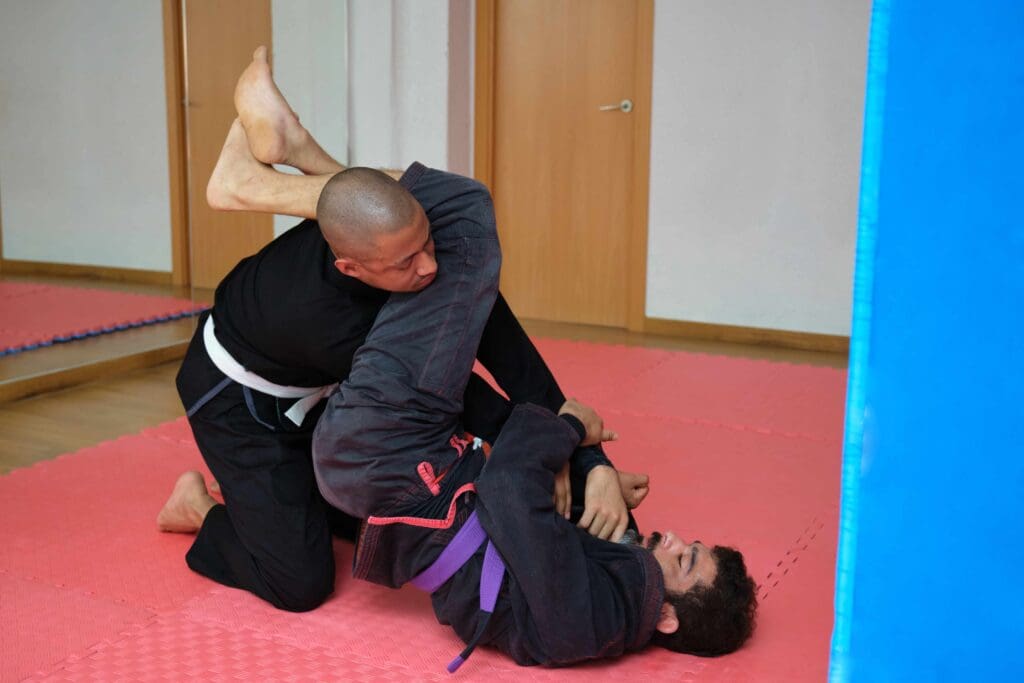
- Next comes drilling. You and a training partner practice the demonstrated technique cooperatively, usually taking turns. The goal is repetition and correct mechanics, not beating your partner.
For example, if you are learning an escape from mount, your partner provides the appropriate position while you work through the escape. Then you switch roles. Drilling is where a technique that looked simple during the demonstration suddenly becomes very real. Your foot is in the wrong place. Your elbow disappeared somewhere. You forgot which direction to turn. That is part of learning.
4. You Learn One of BJJ’s Most Important Rules: Tap
- Sooner or later, every BJJ beginner needs to understand tapping. A tap tells your training partner to stop immediately. You can generally tap your partner with your hand, tap the mat when appropriate, or verbally say “tap.”
If you are caught in a submission, feel unsafe, or experience pain or uncomfortable pressure, tap. Do not treat tapping as losing. It is one way students can train submissions repeatedly while managing risk. Learning when to stop is part of learning Brazilian Jiu-Jitsu.
Do You Have to Spar During Your First BJJ Class?
- Not necessarily. Live sparring in Brazilian Jiu-Jitsu is usually called rolling. Two practitioners attempt to apply positions, escapes, sweeps, control, and submissions against active resistance. However, beginner policies vary substantially between academies. Some introduce controlled sparring early, while other beginner programs delay competitive rolling entirely. Gracie University’s beginner-oriented Combatives program, for example, specifically separates beginners from competitive sparring.
If your first session includes live training, the instructor should explain what to expect. Ask questions if you are uncertain. Your first roll is not supposed to look impressive. The better goal is to breathe, stay controlled, protect yourself, listen to your partner, and begin recognizing positions.
Do You Need to Be in Shape Before Starting BJJ?
- No special fitness level is required simply to begin learning. BJJ can certainly be physically demanding, but trying to “get fit enough for Jiu-Jitsu before doing Jiu-Jitsu” often becomes an unnecessary delay.
Beginner programs are specifically designed for people who are still developing BJJ-specific conditioning, mobility, and coordination. Recent beginner guidance likewise emphasizes that students can start without first reaching a particular fitness level. Train consistently, and your conditioning can develop alongside your technique.
Is Two Hours of BJJ a Week Enough for a Beginner?
- Two hours a week can absolutely be a useful starting point. For a beginner, consistency generally matters more than immediately trying to train every day. Two regular sessions each week give you repeated exposure to positions and techniques while allowing recovery between classes.
As your body adapts and BJJ becomes part of your routine, you can decide whether adding another training session makes sense. Avoid comparing your schedule with the student who seems to live at the academy. Your progress is your progress.
What Will You Feel Like After Your First Class?
- Probably a combination of tired, confused, and curious. You may discover muscles you rarely use during conventional workouts. You might also replay one particular technique in your head on the drive home through Randolph.
That mental challenge is part of BJJ’s appeal. Brazilian Jiu-Jitsu has often been described as physical problem-solving: your partner creates a problem, you apply technique, they respond, and you adjust. The first class introduces the vocabulary. Regular training teaches you how to have the conversation.
What Beginners Should Remember on Their First Day
- You do not have to win anything.
- You do not need to impress the instructor.
- You do not have to memorize every technique.
- And you definitely should not try to compensate for inexperience by using as much strength as possible.
- Focus instead on listening, moving carefully, asking questions, tapping when needed, and being a good training partner.
Those habits will take you much further than trying to “survive” your first class.
Start Brazilian Jiu-Jitsu Training in Randolph, NJ

If you have been considering BJJ but keep putting off your first class because you do not know what to expect, the simplest answer is this: show up ready to learn. Morris County Wrestling & Martial Arts offers Brazilian Jiu-Jitsu training in Randolph, NJ for students looking to develop grappling skills, fitness, confidence, self-defense ability, or competitive experience.
The family-owned academy founded by Mike and Vic Amada serves beginners and experienced athletes throughout Randolph, Dover, Morristown, Rockaway, and Morris County. Want to see what BJJ actually feels like instead of wondering about it? Call Morris County Wrestling & Martial Arts at (973) 713-3556 or email mcwandma@gmail.com to ask about Brazilian Jiu-Jitsu classes and get started.