Do You Need Experience for Women’s Self-Defense Training?
If you’re a woman who wants to feel safer and more confident but worries that you’re “not athletic enough,” have never thrown a punch, or would feel uncomfortable walking into a martial arts gym, you’re exactly the kind of person beginner self-defense training is designed for. Many women delay taking a class because they assume everyone else will already know what they’re doing.
In reality, you do not need previous martial arts experience, exceptional strength, or advanced fitness to start women’s self-defense training. At Morris County Wrestling & Martial Arts in Randolph, instruction helps beginners build practical skills gradually in a supportive environment, rather than expecting them to arrive already knowing how to defend themselves.
Do You Need Experience to Take a Women’s Self-Defense Class?
- No. You do not need any previous martial arts or self-defense experience to begin women’s self-defense training. Beginner-friendly training starts with fundamental skills and progresses from there. You are not expected to understand fighting stances, striking combinations, grappling, or escape techniques before your first session.
In fact, starting with no experience has one advantage: your instructor can teach you proper habits from the beginning. This matches what many beginner self-defense programs emphasize. Classes typically introduce basic movement, awareness, simple physical techniques, and controlled partner drills rather than immediately placing beginners into high-intensity situations.
What Do Beginners Learn in Women’s Self-Defense Training?
Self-defense is about much more than learning how to punch someone. A practical program should help you spot problems early, respond confidently, and know your options if someone threatens your safety.
Situational Awareness
- One of the first skills beginners can develop is noticing what is happening around them. Imagine leaving a restaurant in Morristown after dark or walking across a parking lot after an evening shift in Randolph. Situational awareness means recognizing unusual behavior, maintaining appropriate distance, identifying exits, and avoiding becoming unnecessarily distracted.
The best outcome is often recognizing trouble early enough that physical confrontation never becomes necessary. Research into women’s resistance training also supports the importance of risk recognition, assertiveness, and both verbal and physical responses rather than treating self-defense as purely fighting.
Basic Striking Techniques
- Beginners may also practice straightforward strikes that do not require years of martial arts training. Depending on the program, that may include movements such as palm strikes, elbows, knees, or other simple defensive actions.
Focus on proper mechanics and an appropriate response, not memorizing flashy combinations. You learn the movement slowly first. Then you repeat it. That repetition is where confidence starts developing.
Escaping Common Grabs and Holds
- Another common beginner concern is, “What would I do if someone grabbed me?” Self-defense training can introduce principles for dealing with situations such as wrist grabs, holds, or someone entering your personal space.
Learning an escape once does not make it automatic. Practicing movements repeatedly under professional instruction helps you feel more comfortable responding when pressure increases.
Do You Need to Be Strong or Fit Before Starting?
No. Waiting until you “get in shape” before taking self-defense classes is a little like waiting until you know how to swim before taking swimming lessons. You train partly to become more capable. Early sessions can be adjusted to your current ability, while regular training may gradually improve:
- Cardiovascular endurance
- Coordination
- Balance
- Strength
- Reaction time
- Mobility
- Confidence under pressure
Good self-defense training should not depend entirely on overpowering somebody. Technique, positioning, timing, movement, and decision-making matter too. If you have been inactive for a while, simply tell your instructor. There is no prize for exhausting yourself during your first class.
What Should You Expect at Your First Self-Defense Class?
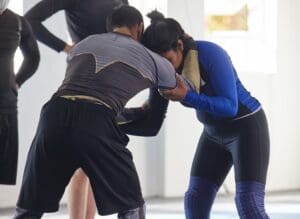
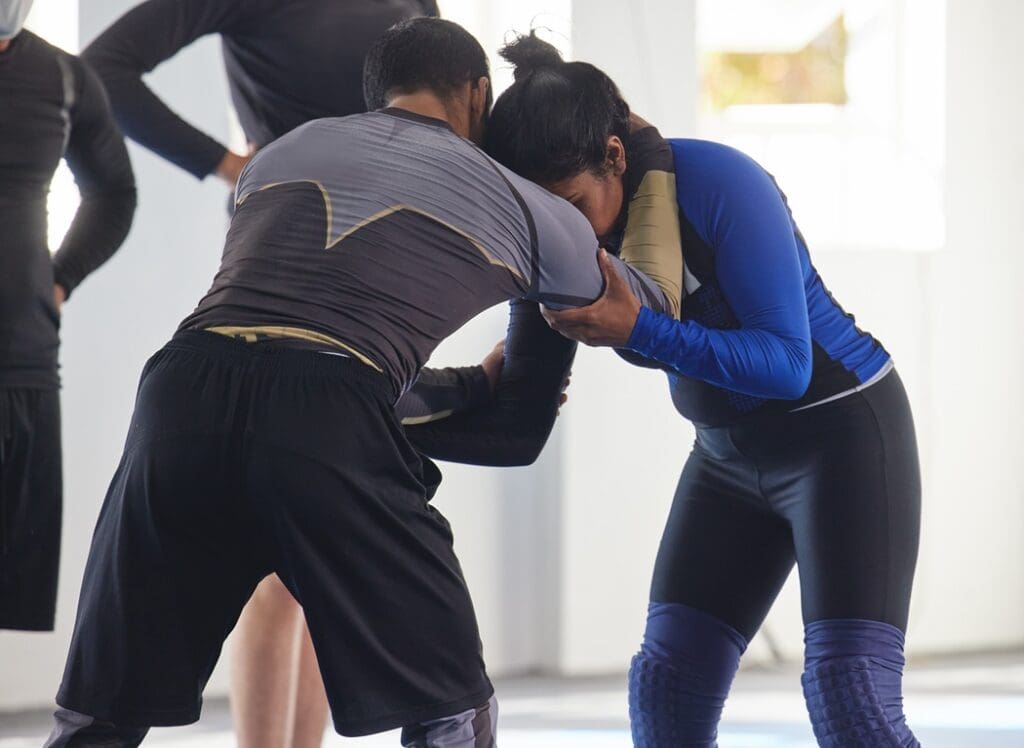
- Walking through the door is often more intimidating than the training itself. A first session will typically introduce the environment and fundamental movements before asking you to apply anything with meaningful resistance. Beginner programs commonly use a warm-up, instructor demonstrations, basic movement or striking, and controlled partner practice.
You might feel awkward. That is completely normal. Someone demonstrating a movement smoothly may have practiced it hundreds of times. You are doing it for the first time. Nobody should expect those two performances to look the same. A quality instructor breaks the technique into manageable pieces, corrects your positioning, and gives you opportunities to repeat it.
Is Women’s Self-Defense the Same as Martial Arts?
- Not exactly, although there can be considerable overlap. Self-defense training focuses specifically on skills and decisions that may help you respond to threatening situations. Martial arts such as Brazilian Jiu-Jitsu, Boxing, Muay Thai, and MMA develop broader fighting skills through ongoing technical practice.
Training in martial arts can complement self-defense because you repeatedly practice movement, striking, grappling, timing, and responding to resistance. At Morris County Wrestling & Martial Arts, students also have access to disciplines including Brazilian Jiu-Jitsu, Muay Thai, Wrestling, Boxing, and MMA, allowing someone who starts with self-defense to explore additional training if she wants to build her skills further.
Can Self-Defense Training Actually Improve Confidence?
- It can, particularly when confidence comes from skills that have actually been practiced. Research published in Violence Against Women found that participants in a 10-week self-defense program reported greater confidence in their ability to resist assault and were less likely to experience sexual assault during follow-up than comparable women who did not participate.
A more recent research review also found evidence that women’s self-defense programs can improve important outcomes, while noting that additional research is still needed to determine which program characteristics work best across different populations. That distinction matters.
- A self-defense class cannot promise that you will never face danger or guarantee the outcome of a confrontation. What training can do is give you more knowledge, practiced options, awareness, and experience responding under controlled pressure.
How Long Does It Take to Learn Women’s Self-Defense?
- You can learn useful concepts during your first few sessions, but self-defense is not something most people truly master in one afternoon. Think of it like any physical skill. Understanding how to escape a grab is different from performing that escape quickly when someone is resisting you.
Regular practice helps movements become more familiar and helps you stay composed while applying them. Consistency is more valuable than trying to learn dozens of techniques at once. Start with a handful of practical skills. Practice them correctly. Then build from there.
What Should You Wear to Your First Class?
For most beginner self-defense classes, comfortable workout clothing that allows you to move freely is a sensible choice. Avoid clothing or accessories that limit movement. Before attending, ask the academy whether you need specific shoes, gloves, protective equipment, or other gear for that particular class. You generally do not need to show up on day one with a closet full of martial arts equipment.
How Do You Choose a Beginner-Friendly Self-Defense Class?
Before joining a program, look beyond claims about learning to “fight.” A strong beginner environment should include instructors who explain why techniques work, allow students to progress gradually, emphasize awareness as well as physical skills, and create an atmosphere where asking questions is encouraged. Consider asking:
- Is the class appropriate for someone with zero experience?
- How much physical contact should I expect?
- Are techniques practiced against resistance?
- What should I bring to my first session?
- Can the instructor accommodate different fitness levels?
- Is there an opportunity to try a class before committing?
Morris County Wrestling & Martial Arts specifically welcomes athletes at different experience levels and offers a free opportunity to try its classes. The academy serves students throughout Randolph, Dover, Morristown, Rockaway, Denville, and surrounding Morris County communities.
Starting With Zero Experience Is Completely Fine

You do not need to become stronger, fitter, tougher, or more experienced before learning how to protect yourself. You start where you are. The early goal is not to become an expert fighter overnight. It is to learn awareness, understand basic defensive principles, practice practical movements, and gradually become more comfortable responding under pressure. And after that? You keep building.
If you have been considering women’s self-defense classes in Morris County but have hesitated because you have never trained before, Morris County Wrestling & Martial Arts can help you take that first step in a supportive training environment. Call (973) 713-3556 or email mcwandma@gmail.com to learn more about women’s self-defense training in Randolph, NJ and find the right class for your experience level.
Frequently Asked Questions
Can I take self-defense classes if I have never exercised before?
Yes. Previous exercise or martial arts experience is not normally required for beginner self-defense training. Tell your instructor about your current fitness level so training can progress appropriately.
Am I too old to start women’s self-defense?
There is no single ideal age for beginning self-defense. Appropriate training can be adapted for different ages and abilities, although anyone with medical or mobility concerns should discuss them with an instructor and healthcare professional when appropriate.
Will I have to fight someone during my first class?
Beginner classes generally introduce techniques in a controlled environment before increasing resistance or intensity. Ask the academy about its specific class format if physical contact makes you nervous.
Can women’s self-defense help if an attacker is larger?
Self-defense training cannot guarantee an outcome against a larger or stronger attacker. However, training can teach awareness, positioning, timing, targeting, escape principles, and practiced responses that do not rely solely on matching another person’s strength.