Most women considering a self-defense class are weighing one question: is this actually going to change anything, or is it an hour a week that makes me feel briefly better? It’s a fair question, and the answer is more specific than “you’ll feel empowered.”
Here’s the honest version. Self-defense training changes three things: what you notice, what you’re willing to say, and what you do with your hands if the first two don’t work. The first two matter more than the third, and they’re the ones that show up fastest.
Table of Contents
ToggleWhat changes first, and it isn’t punching
In the first few weeks, the change isn’t physical. It’s that you stop rehearsing worst cases and start reading situations.
Awareness is the part instructors spend real time on, because it’s the part that keeps you out of situations rather than getting you out of them. It’s practical and learnable, and the gym’s own class description puts it plainly: recognizing and avoiding dangerous situations before they escalate. None of that requires strength or athleticism, which is why a class pays off long before you can throw a decent strike. The habits themselves are worth a read on their own, and how women can stay aware and avoid dangerous situations covers them.
The second change is your voice. A loud, flat “no” with your hands up and your feet set is a real tool, and most people have never once practiced saying it. In class you do, out loud, until it stops feeling strange.
Setting a boundary is a skill, not a personality trait
Self-defense classes teach posture, eye contact, tone and distance. You learn how much space to keep, how to use your body to signal that you’re not an easy target, and how to say a flat sentence that closes a conversation.
That transfers. The woman who can hold her ground with a stranger at a gas pump is the same woman who can end a pushy sales call or shut down a colleague who keeps interrupting. It isn’t a motivational idea. It’s the same set of behaviors, practiced in a place where getting it wrong costs nothing.
Randolph, NJ
Thinking about a first self-defense class?
Ask what a session involves and how beginners are started.
The physical skills, and what they realistically cover
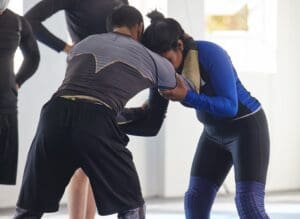
When technique does come in, good training keeps it narrow and repeatable, because that’s what holds up when you’re scared. A women’s self-defense class generally covers:
- Breaking grips. Getting a wrist, arm or clothing grab off you, using leverage rather than strength.
- Creating distance. Getting back to arm’s length or further, which is where you have options.
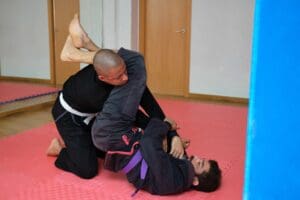
- Escaping holds. Getting out from behind, off a wall, or off the ground, since that’s where size differences hurt most.
- A few strikes that work tired. Palm, elbow, knee. Short, simple tools, not combinations.
- Getting away. Every sequence ends with leaving, not with winning.
The gym’s own class outline adds two things worth knowing before you go. One is using everyday objects as tools, which is a more realistic answer than assuming you’ll be empty-handed with both hands free. The other is practicing in simulated real-life scenarios rather than only drilling techniques in the air: being grabbed from behind while distracted is a different problem from performing an escape you knew was coming, and the gap between the two is where most training falls down.
The classes are built for women of all ages and fitness levels, beginners included, and a session runs from a warm-up through core techniques into those scenarios before a cool-down. The gym is in Randolph, in the middle of Morris County.
At Morris County Wrestling and Martial Arts, the coaches draw on wrestling, Brazilian Jiu-Jitsu and striking, which is a useful mix for this: grappling is what answers being grabbed or taken down, and striking covers the distance before that. To see what each coach trains in, the coaches page lays it out.
Independence is the part people underrate
A lot of women arrange their lives around avoidance: not parking there, not going at that hour, not going alone. Training doesn’t make the world safer, but it does change what you’re willing to do in it. Going to the evening class, taking the later train, running the errand after dark: those decisions get easier when you’ve practiced what you’d do.
That’s a smaller promise than “you’ll never be afraid,” and it’s the one training actually keeps.
Questions about the women’s self-defense class before you come in? Call the gym in Randolph.
What self-defense training can’t promise
This matters as much as the benefits, and most articles skip it.
No class makes you safe. Training improves your odds and your options. It cannot promise an outcome, because attacks aren’t fair fights and nothing works every time. Any program promising otherwise is selling something.
It also isn’t therapy. A gym is not a substitute for professional support, and good coaches will say so.
And it isn’t one-and-done. A single workshop teaches you concepts; the physical detail fades within weeks without repetition. What sticks is what you practice. That’s an argument for an ongoing class over a one-off session, if you have the choice.
Who it suits
Beginners, mostly. People walk in with no athletic background, no experience and a fair amount of nerves, which is the normal starting point rather than the exception. If that’s the sticking point for you, do you need experience to start women’s self-defense training? answers it directly.
Reading about a grip break is not the same as drilling one, so treat anything you read, here included, as preparation for showing up rather than a substitute for it.
If you’d rather start alongside people you know, ask whether the gym runs sessions for groups, workplaces or schools.
Frequently asked questions
What are the real benefits of a women’s self-defense class?
Better awareness and judgment about situations, the practiced ability to set a boundary out loud, a small set of techniques for being grabbed or held, and the confidence that comes from having rehearsed it rather than imagining it.
How long before it’s useful?
The awareness and voice habits start changing within a few sessions. The physical skills take longer and need repeating, which is why consistency beats intensity.
Will I have to fight someone in class?
In a women’s self-defense class the drills are usually cooperative: a partner gives you the grab or the hold so you can practice getting out of it, which is a different thing from sparring. Ask the gym how it runs the class before your first session.
Self-defense training won’t hand you fearlessness. What it gives you is a set of specific, practiced responses, and the quieter confidence of knowing what you’d do. If that’s what you’re after, the gym’s women’s self-defense classes in Randolph are where to start.
Women’s self-defense at Morris County Wrestling and Martial Arts
A father-and-son gym, rated 5.0 on Google. Head Coach Mike Amada holds a 4-0 MMA record, and Wrestling Coach Vic Amada was inducted into the Randolph High School Hall of Fame in 2022.
Morris County Wrestling and Martial Arts
1248 Sussex Turnpike B11, Randolph, NJ 07869
Serving Randolph and Morris County