Increase Muay Thai Striking Power Without Sacrificing Technique
For Muay Thai students who feel their punches and kicks lack impact, trying to hit harder can create an even bigger problem: tense shoulders, poor balance, telegraphed movements, and sloppy technique. Real power does not come from swinging as hard as possible. It comes from coordinating your feet, hips, core, and striking limb at the right moment. At Morris County Wrestling & Martial Arts in Randolph, students learn technique-first striking mechanics that build power without sacrificing speed, control, or defensive positioning.
You have probably seen someone throw everything into a heavy-bag kick, only to stumble sideways or drop both hands afterward. The strike may have sounded powerful, but it left the person vulnerable. In Muay Thai, usable power must leave you balanced enough to defend, counter, or continue your combination. The goal is not simply to hit harder. It is to create more force with less wasted movement.
What Creates Power in Muay Thai Strikes?
Muay Thai striking power is created through the kinetic chain, meaning force travels through the body in sequence. The movement begins at the floor. Your foot pushes against the ground, your legs and hips rotate, your core transfers the energy, and your hand, shin, knee, or elbow delivers it into the target.
Research on roundhouse kicks highlights the importance of pelvic rotation, hip movement, knee extension, and coordinated movement toward the target. Powerful kicking therefore depends on whole-body mechanics, not just strong legs.
When one part of the chain is stiff, late, or incorrectly positioned, power leaks away. Common examples include punching mainly with the arm, kicking without pivoting, rotating the shoulders without the hips, and falling out of stance after contact.
How to Increase Power in Muay Thai
Push From the Floor
- Every powerful strike begins with a stable connection to the ground. For a rear cross, push through the ball of your rear foot as your hip and shoulder rotate. For a roundhouse kick, rise onto the ball of the supporting foot and pivot as the hip turns toward the target. Without that pivot, the hips cannot rotate freely. The kick becomes stiff and relies too heavily on the leg.
Practice the movement slowly before increasing your speed. Your foot, hip, torso, and striking limb should work together rather than moving as separate parts.
Rotate Your Hips and Core
- Many beginners try to generate power by swinging the arm or leg harder. This usually creates a bigger movement, but not necessarily a better strike. For punches, imagine that your hip is delivering your hand. Your shoulder follows the hip rotation while your arm remains relaxed.
For kicks, turn your hip through the target instead of simply lifting and swinging your leg. A useful drill is to place your hands on your hips and practice the supporting-foot pivot without throwing the kick. Once the rotation feels natural, add the leg.
Stay Relaxed Until Impact
- Trying harder does not always make a strike harder. If you tense your shoulders, fists, arms, and legs before the strike begins, you slow yourself down and waste energy. You may also telegraph the attack.
Stay loose during the setup and acceleration. Briefly tighten the relevant muscles at impact, then relax as you return to your stance. Think of the strike like a whip. It should accelerate smoothly and finish sharply rather than feeling like a slow push.
Transfer Weight Without Losing Balance
Weight transfer allows you to place more of your body behind a strike, but leaning too far can leave you exposed.
After each punch, kick, or knee, ask yourself:
- Can I return immediately to my stance?
- Are my hands still protecting my head?
- Could I defend a counterattack?
- Can I throw the next strike without repositioning my feet?
When the answer is no, you are probably sacrificing control for power.
How to Kick Harder Without Losing Technique
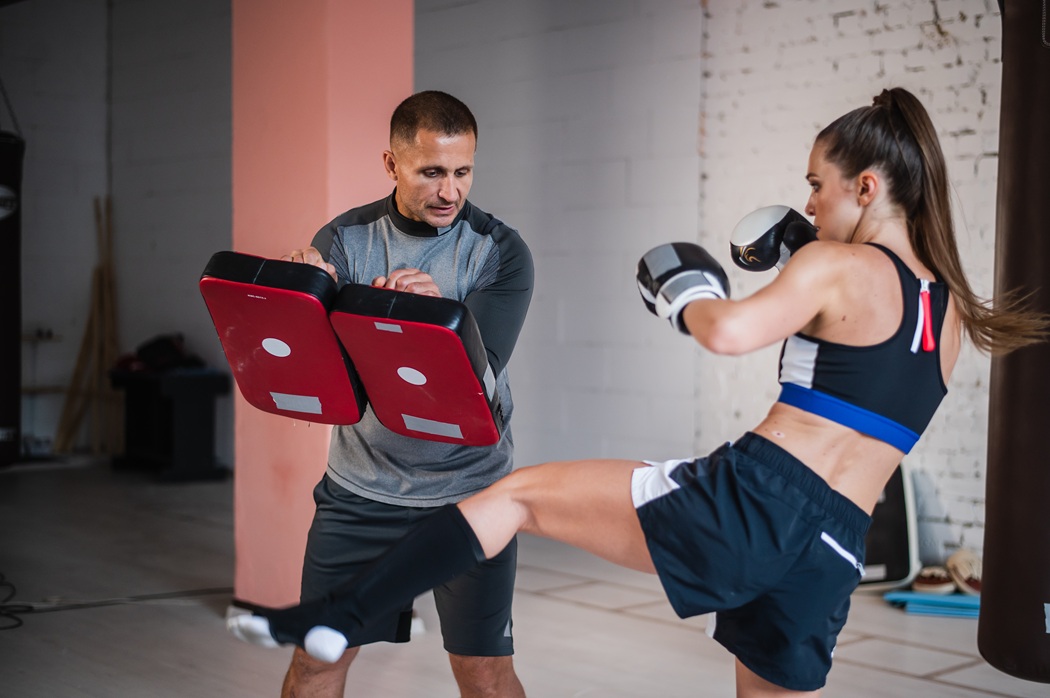
A hard Muay Thai roundhouse kick depends on the supporting foot, hip rotation, posture, range, and recovery. Use this sequence:
- Move into the correct striking range.
- Push through the supporting leg.
- Pivot on the ball of the supporting foot.
- Rotate the hip toward and through the target.
- Connect with the shin rather than the foot.
- Keep your eyes on the target and protect your head.
- Recover into a balanced fighting stance.
Do not judge every kick by how far the heavy bag swings. A bag may swing because it was pushed rather than struck cleanly. Focus on sharp contact, proper rotation, posture, and recovery.
Best Drills for Developing Muay Thai Power
Single Power Strikes
- Throw one clean power strike at a time on the heavy bag. Pause after each repetition and check your stance, guard, balance, and breathing. Reset fully before throwing the next strike. This makes it easier to identify whether your power is coming from proper mechanics or uncontrolled momentum.
Technique-to-Power Rounds
Begin the round at approximately 50 to 60 percent power. Focus on your pivot, hip rotation, breathing, accuracy, and return to stance. Gradually increase the intensity while preserving the same form. Reduce the power as soon as your guard drops or your balance deteriorates.
Pad Work
- Pad work gives you immediate feedback on range, timing, and body mechanics. A qualified coach may notice that you are standing too close to extend your cross, failing to rotate your hip, or dropping your opposite hand during a kick. Correcting one small issue can noticeably improve impact.
Count Clean Repetitions
Choose one strike and set a target, such as 15 clean rear kicks per side. Do not count a repetition if you lose balance, use the wrong range, drop both hands, or need several steps to recover. Tracking technically correct strikes is more useful than counting every attempt.
Medicine-Ball Throws
- Rotational medicine-ball throws help develop explosive hip and torso movement. Rotate through your feet and hips rather than throwing only with your arms. Strength exercises such as squats, split squats, push-ups, rows, loaded carries, and controlled jumps can also support striking power. However, strength training should complement Muay Thai practice, not leave you too tired to train with proper technique.
How Can You Punch Faster Without Losing Power?
Punching speed and power are not opposites. Both improve when movement becomes efficient. Keep your shoulders relaxed, rotate from the floor and hips, take the shortest path to the target, and return the hand directly to your guard. Avoid pulling the hand backwards before punching because this telegraphs the strike and adds unnecessary movement.
Use short, controlled exhales as your strikes land. Holding your breath increases tension and causes you to fatigue more quickly.
Common Mistakes That Reduce Striking Power
- Loading up before a strike warns your opponent and slows the attack. Keep your movements compact and generate force through rotation. Training at maximum power during every round is another mistake. Constantly trying to destroy the bag can lead to fatigue, poor form, and unnecessary joint strain.
Distance also matters. A punch thrown too close becomes cramped, while a kick thrown from too far away may connect with the foot instead of the shin. Finally, remember that a strike is not finished at impact. It is finished when you have safely returned to your stance.
Develop More Powerful Muay Thai Strikes in Morris County

- Students from Randolph, Dover, Morristown, Rockaway, and surrounding Morris County communities begin Muay Thai for different reasons. Some want a demanding workout, while others want practical striking skills, confidence, or competition preparation.
Regardless of the goal, power begins with the same foundation: proper stance, efficient movement, accurate technique, balance, and consistent coaching.
- At Morris County Wrestling & Martial Arts, students receive hands-on instruction through technical drilling, pad work, bag training, and conditioning appropriate for their experience level. Beginners are welcome, and you do not need to be in fighting shape before starting.
To improve your striking power without sacrificing technique, contact Morris County Wrestling & Martial Arts in Randolph, NJ. Call (973) 713-3556 or email mcwandma@gmail.com to learn more about Muay Thai classes.